Yerba Santa
Eriodictyon californicum
by Patricia Kaminski and Richard Katz
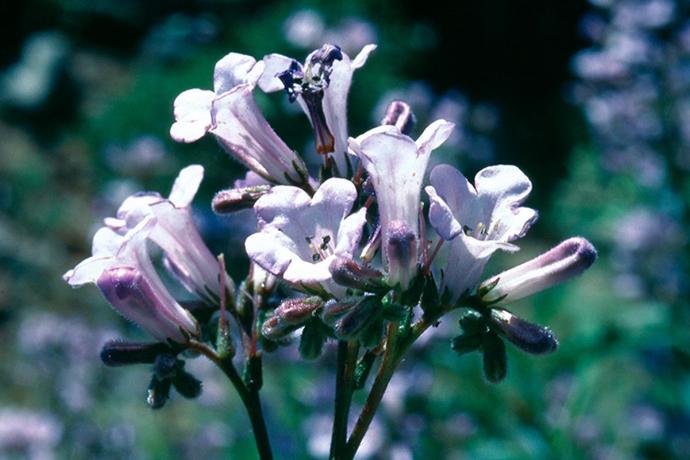
The common names of Yerba Santa
include Mountain Balm, Bear's Weed, Gum Plant, Consumptive Weed, and
Sacred Herb. It was used medicinally by Native America healers for many
centuries, and then taken up by the Spanish settlers, who gave it its
current name, meaning "Holy Herb."
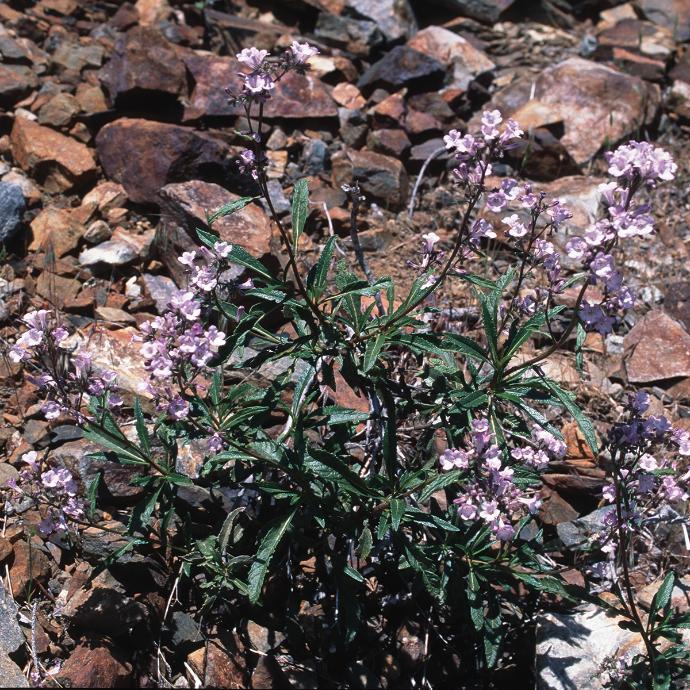
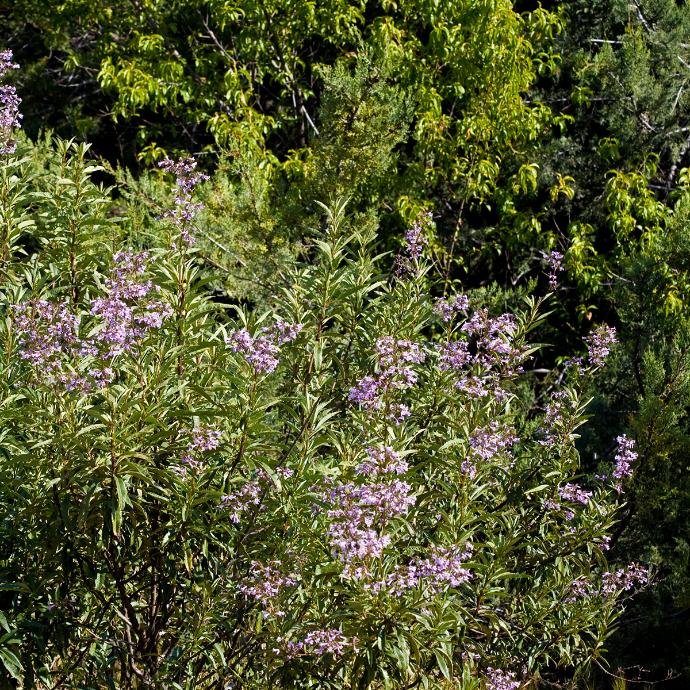
Yerba Santa is an evergreen
aromatic shrub with woody rhizomes, typically growing to a height of 3
to 4 feet (1 m +) The dark green, leathery leaves are oblong to
lanceolate and covered with shiny resin. They grow in an alternate
arrangement and are pinnately veined and usually serrate. The taste of
the leaves is balsamic and the flowers and leaves smell pleasantly
aromatic on a warm day. Yerba Santa is native to the western and
southwestern regions of North America, and is somewhat native to
northern Mexico. It grows 2-6 feet in height at elevations ranging from
2000 to 3,500 ft. It is typically found in dry areas that are sparse of
other vegetation. The flowers are a delicate whitish-lavender color,
found in curved tubular clusters (helicoid cymes) at the top of the
plant, and are pollinated by butterflies. Yerba Santa blooms from May to
July, depending on the elevation. The fruit forms a grayish-brown seed
capsule, oval in shape, which contains hardened black seeds.
Yerba Santa is an excellent herbal remedy for chronic respiratory ailments, used as an expectorant to treat coughs and congestion.
Yerba Santa is an exceptional member of the Waterleaf Family (Hydrophyllaceae) which also contains Phacelia, Baby Blue Eyes and Fiesta Flower. Most of these family members grow in cool, moist habitats, indicating a strong relationship to the watery element. Yerba Santa also has a relationship with water, although in an opposite way. With its tough, resinous leaves, it holds and conserves its water from the inside to meet the intense fire of its environment. This quality helps us to understand the medicinal use of Yerba Santa as a regulator of the water element. Yerba Santa coats the mucous membranes and holds the aqueous component in contact with the cells, reestablishing mucopolysaccharides. As such, it is an excellent herbal remedy for chronic respiratory ailments, used as an expectorant used to treat coughs and congestion, as well as aiding in loosening and expelling phlegm. It dilates bronchial tubes, and thus is used to ease asthma and allergy attacks. A tea, tincture or syrup is typically made from the leaves, sometimes including the flowers, or as a smoke from the leaves.
With its tough, resinous leaves, Yerba Santa holds and conserves its water to meet the intense fire of its environment. The qualities of Yerba Santa flower essence emerge from this portrait, making it particularly useful for those affected by emotions associated with the water element such as grief, depression, and despair.
A picture of the soul qualities of the Yerba Santa essence emerges from this botanical herbal portrait. Yerba Santa flower essence is indicated for those who hold in the water element, especially manifest in the emotions of grief, melancholy, depression or despair. These emotions are stored in the deeper cavities of the body, particularly in the heart/ lung/respiratory region. The free flowing, or "breathing out" of soul expression is often impeded. Respiratory illnesses, addiction to tobacco, and various allergies are common physical manifestations of this soul imbalance.
Yerba Santa frees the lungs and heart to acknowledge and release stored emotional experience. Yerba Santa was regarded as a holy herb by the native peoples, because the process of awakening, and claiming deep soul experience leads to the indwelling Temple of the Spiritual Self. It is often in those places where the soul retains the most profound pain or trauma, that the strongest teachings of the Spiritual Self can also be realized.
The color and form of
the Yerba Santa is truly a signature of these soul qualities—the
delicate lavender flowers suggest a highly refined level of spiritual
awareness. And at the same time the curving, tubular shaped flowers
speak to a process of descent into the deepest parts of the soul temple.
The insights of Matthew Wood, in Seven Herbs Plants as Teachers capture
in a most touching way, these qualities of Yerba Santa:
The
inner spaces defined by the body lining are "sanctuaries," from which
impurities must be kept. Perhaps it was an intuitive recognition of this
which gave the plant its name: Yerba Santa...the internal body linings
correspond with "psychic body linings." Sanctity of psychic space is the
internal property which Yerba Santa guards.

To install this Web App in your iPhone/iPad press  and then Add to Home Screen.
